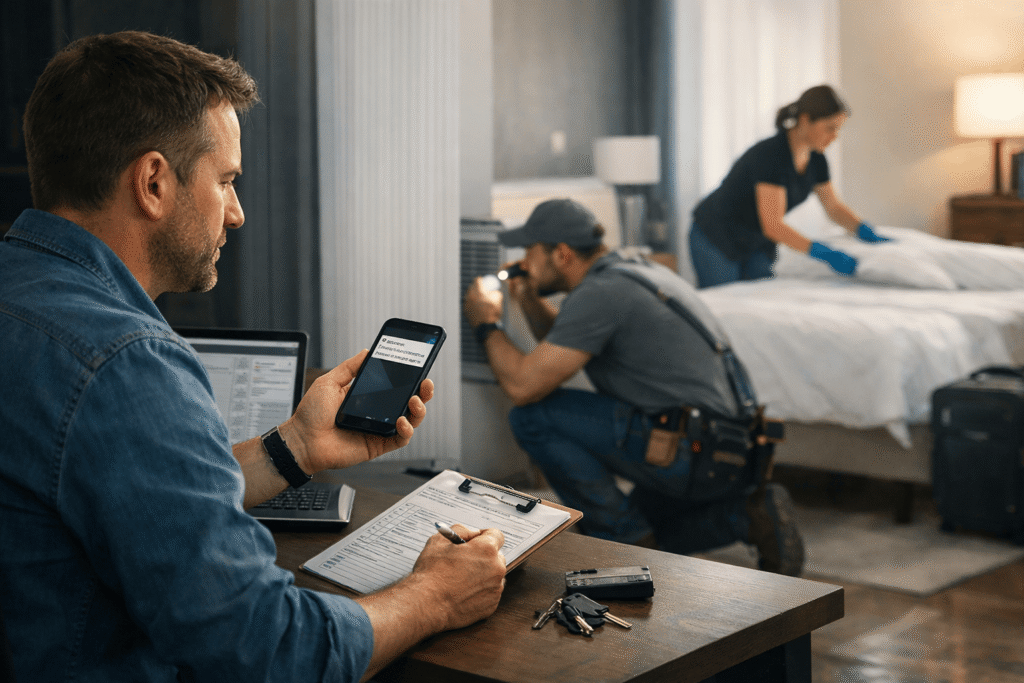
A guest sends a message at 9:14 PM:
“The thermostat isn’t cooling.”
Within minutes, the operator is stressed. The guest is uncomfortable. A vendor is called. An after-hours visit is approved. The bill comes in higher than expected.
Then the technician arrives and finds the issue was simple.
The thermostat was set incorrectly.
The breaker had tripped.
The guest misunderstood the controls.
The issue was real.
But the dispatch did not need to happen.
That is how maintenance gets expensive in short-term rentals.
Not because every vendor is overcharging.
Not because every issue is severe.
And not because maintenance problems can be avoided entirely.
STR operators overpay for maintenance because their operations are reactive.
When there is no structured triage, no urgency framework, and no clear routing logic, too many issues get treated like emergency dispatches.
At a small scale, that feels manageable.
At 5+ properties, it starts quietly draining margin.
The Real Cost of Maintenance Is Bigger Than the Invoice
Most operators think maintenance cost means the repair bill.
But the actual cost is much wider than that.
It includes:
- unnecessary dispatches
- after-hours callout fees
- repeated vendor visits
- slower guest response times
- operator interruption
- poor issue handoffs
- recurring problems that never get fixed at the system level
A $120 service call is rarely just a $120 service call.
It can also mean a disrupted evening, a frustrated guest, a delayed turnover, extra back-and-forth with vendors, and the same issue showing up again on the next booking.
That is where many STR operators lose money.
Not because maintenance happens.
Because the handling around maintenance is weak.
5 Reasons STR Operators Overpay for Maintenance
1. They dispatch too early
A guest reports a problem, and the default response is to send someone immediately.
That feels responsive.
But it often creates unnecessary cost.
Not every issue needs a vendor. Some need better guest guidance. Some need a cleaner follow-up. Some need a quick remote check. Some are not true maintenance issues at all.
Without triage, every issue starts looking like a dispatch.
That shortcut gets expensive fast.
2. They send the wrong person
A smart lock issue gets sent to a handyman.
A Wi-Fi issue gets treated like a maintenance emergency.
An appliance complaint gets escalated before anyone checks the basic settings.
Now the issue takes longer, costs more, and sometimes requires a second visit because the first response was misrouted.
This is not just a vendor issue.
It is an operations issue.
3. They skip basic troubleshooting
Some of the most common guest-reported problems are not full maintenance failures.
They are usage issues, reset issues, or confusion that could be narrowed down quickly with the right questions.
This often includes:
- thermostat settings
- router resets
- breaker checks
- smart lock behavior
- appliance mode confusion
Without a standard troubleshooting flow, operators jump straight from complaint to dispatch.
That jump is where avoidable cost starts.
4. They treat every issue like an emergency
Not every maintenance issue has the same urgency.
A lockout is not the same as weak air conditioning.
A water leak is not the same as a missing kitchen item.
A full power outage is not the same as a microwave not heating properly.
But when operators are overloaded, decisions get made from stress instead of structure.
When everything feels urgent, unnecessary dispatches increase and true emergencies become harder to prioritize.
5. They do not track recurring issues
The same thermostat gets flagged over and over.
The same lock keeps confusing guests.
The same appliance keeps generating complaints.
But if the issue only lives inside inbox threads or scattered notes, it never becomes a system-level fix.
So the operator keeps paying for the same confusion again and again.
Recurring issues should lead to:
- better guest instructions
- cleaner checklists
- hardware replacement decisions
- routing changes
- stronger troubleshooting steps
If they do not, maintenance becomes a leak in the operation.
What Unnecessary Dispatches Usually Look Like
Many guest-reported problems sound serious at first.
That does not mean they all require an immediate vendor call.
“The thermostat isn’t cooling.”
This could be a real HVAC issue. But it could also be incorrect settings, blocked airflow, delayed recovery after check-in, or simple guest confusion.
“The lock isn’t working.”
This may be urgent. But it could also be door pressure, guest input error, low battery warning, or code timing confusion.
“The Wi-Fi is down.”
Sometimes it is. Sometimes it is a single-device issue, the wrong network, or a router that simply needs a reset.
“The refrigerator isn’t cooling.”
That could be serious. Or it may be newly restocked, overfilled, or set incorrectly.
The goal is not to dismiss the guest.
The goal is to classify before dispatching.
A Simple Example of Better Maintenance Handling
Here is the difference in real terms.
Reactive handling
Guest says the thermostat is not cooling.
Operator panics.
Vendor is called immediately.
After-hours fee is approved.
Technician arrives.
Problem was incorrect settings.
Result: money spent, time lost, guest stress, no system improvement.
Structured handling
Guest says the thermostat is not cooling.
Issue is classified under climate and comfort.
Urgency is assessed.
A short troubleshooting flow begins.
Guest is guided through settings and breaker check.
Issue is resolved remotely.
The property note is updated for future stays.
Result: no avoidable dispatch, faster resolution, better documentation, lower repeat friction.
That is the difference between reacting and operating with structure.
The STR Maintenance Triage Framework
The fix is not just finding cheaper vendors.
The fix is improving what happens before a vendor gets called.
A simple triage framework can reduce avoidable maintenance cost while improving response quality.
Step 1: Classify the issue
Every guest issue should be categorized first.
For example:
- Access
- Climate and comfort
- Plumbing
- Electrical
- Appliance
- Internet and tech
- Cleanliness
- Safety and security
Classification immediately improves routing.
Step 2: Assess urgency
A simple urgency structure works well:
Urgent
Safety risk, security risk, active leak, lockout, total power outage
High
Serious guest impact, but not immediately dangerous
Medium
Important, but can wait for standard operating hours
Low
Minor inconvenience or follow-up item
This keeps decisions consistent, even when the operation is busy.
Step 3: Route correctly
Once the issue is classified and prioritized, it should be routed to the right next action:
- guest guidance
- remote troubleshooting
- cleaner follow-up
- onsite support
- vendor dispatch
- operator escalation
This is where cost is either controlled or wasted.
Reactive Maintenance vs Structured Maintenance
Reactive maintenance usually looks like this:
A guest reports a problem.
The operator gets stressed.
Messages go back and forth.
A vendor is called quickly.
The bill is high.
The root cause stays unclear.
The same issue happens again later.
Structured maintenance looks different:
A guest reports a problem.
The issue is categorized.
A short troubleshooting process begins.
Urgency is assessed.
The correct person is routed in.
A dispatch happens only when needed.
The issue is documented for future stays.
The second system is not just cheaper.
It is more scalable, more professional, and easier to control.
Why Maintenance Chaos Gets Worse at 5+ Properties
At 1 to 3 listings, many operators can brute-force maintenance through hustle.
They remember property quirks.
They reply manually.
They coordinate everything in real time.
At 5+ properties, that starts to break.
More properties create more overlap, more messages, more hardware issues, more vendor coordination, and more chances for rushed decisions.
Without systems, the operator loses visibility.
That is when maintenance stops feeling occasional and starts feeling constant.
Growth does not automatically create chaos.
Weak operations do.
What Most PMS Platforms Still Do Not Solve
A PMS is useful.
It centralizes reservations, helps manage calendars, and keeps the portfolio organized at the system-of-record level.
But most PMS platforms do not fully solve the operational layer around the stay.
They do not automatically create good judgment.
They do not replace maintenance triage.
They do not stop operators from overreacting to unclear guest issues.
And they do not always connect guest messaging, cleaner follow-up, troubleshooting, routing, and escalation into one clean system.
That gap is where avoidable maintenance cost usually lives.
It is not that the PMS failed.
It is that many operators expect it to carry more operational weight than it was designed to handle.
What Better Maintenance Operations Actually Look Like
Better maintenance operations do not start with dispatch.
They start with clarity.
That means:
- guest issues are classified quickly
- urgency is assessed consistently
- first-response troubleshooting happens where appropriate
- escalation happens with context, not panic
- repeat issues get documented and turned into process improvements
The goal is not perfection.
The goal is fewer blind decisions, fewer avoidable vendor calls, and a cleaner operating rhythm across the portfolio.
How STR Engine Helps You Reduce Avoidable Maintenance Costs
STR Engine is built around a simple idea:
Most short-term rental operators do not need more people handling chaos. They need better systems behind the operation.
That includes maintenance.
Instead of relying on inbox guesswork and reactive dispatching, operators need structured issue handling with triage logic, urgency rules, routing paths, cleaner coordination, guest communication workflows, and visibility into recurring patterns.
That is how avoidable maintenance spend goes down.
Final Thought
If maintenance feels expensive in your STR portfolio, the real problem may not be the vendor.
No triage. No routing logic. No structure. No operational visibility.
That is exactly the gap STR Engine is built to solve — helping operators create more structure behind maintenance handling before unnecessary cost builds up.
Book a Free Operational Audit